Tallow is everywhere right now, and for good reason. Across TikTok, Instagram, and beyond, people are rediscovering an ingredient traditional cultures used long before it became an internet trend.
Emu oil has a much older story too. Long before it appeared in cosmetic catalogs or research papers, Aboriginal peoples in Australia rendered emu fat and used it as part of traditional healing practices. Historical accounts describe it being rubbed into the skin and used as a liniment or dressing for sore muscles, aching joints, wounds, and dry or injured skin. (Raven, 2021; Abimosleh et al., 2012)
The modern skincare industry did not discover emu oil. Researchers came later and began measuring an ingredient Aboriginal communities had already used through generations of practical and ancestral knowledge. These traditions are not clinical trials, and Australia’s many Aboriginal Nations should not be flattened into one identical practice. But that history matters, and it deserves to be acknowledged before we talk about what modern studies have found.
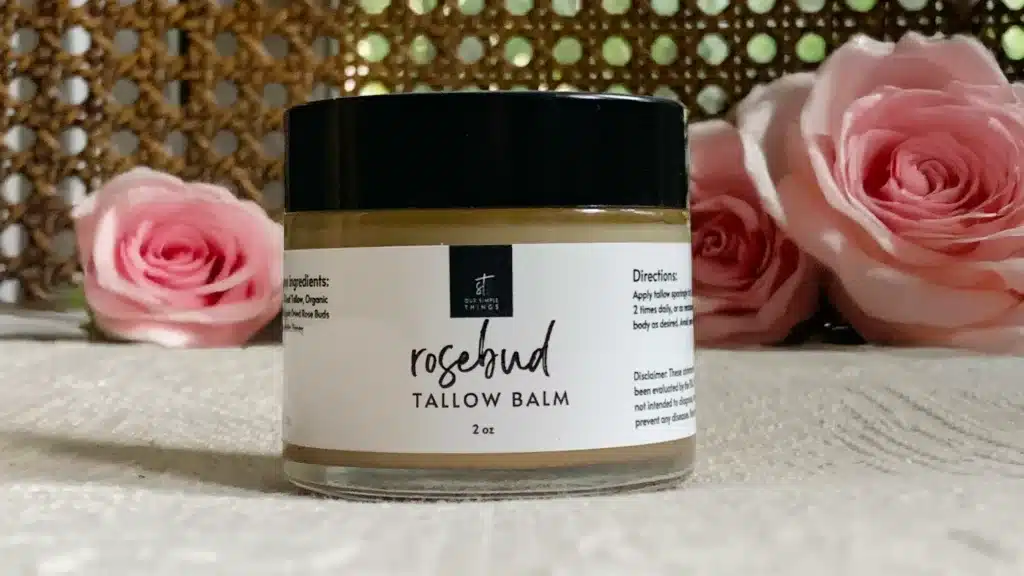
But not all tallow balms are created equal. The quality of the tallow matters. How it is rendered matters. What it is blended with matters. And when you dig into the actual science of skin barrier health, you start to see why the blend can matter just as much as the ingredient printed on the front of the jar.
The short version is this: I use grass-fed and grass-finished tallow for its structure, fatty acid profile, and protective feel. I balance it with pasture-raised emu oil because it has a lighter, more unsaturated fatty acid profile and some genuinely fascinating skin penetration research behind it.
If you came here because you just want to see what I make, you can browse our tallow balms here.
If you want to know why I formulate them this way, come nerd out with me for a few minutes. I promise there will not be a quiz.
First, What Does the Skin Barrier Actually Do?
Our skin barrier is like living armor. Its outermost layer, called the stratum corneum, is often described as a brick wall. The skin cells are the bricks. A lipid mixture containing ceramides, cholesterol, and free fatty acids acts like the mortar between them.
Together, these structures slow water loss and help keep irritants, allergens, and microorganisms from getting farther into the skin. When that barrier becomes disrupted, skin may feel dry, tight, flaky, itchy, or unusually sensitive. (Rajkumar et al., 2023)
Imagine a clay pot covered in a beautiful glaze. When the glaze is intact, the pot holds water and stays protected. If that glaze cracks and begins crumbling away, water escapes more easily and the surface underneath becomes vulnerable.
Skin is obviously not pottery, but the picture works.
Cold weather, over-cleansing, harsh products, UV exposure, skin conditions, age, and hormonal changes can all affect how well that outer barrier functions.
Many people try to fix this with petroleum-based ointments or heavy emollient creams, but I think of that as slapping duct tape over cracks in the glaze. It may stop the leaks temporarily and protect what is underneath. Sometimes that is exactly what skin needs.
But duct tape is not glaze.
It covers and protects. It slows water loss. It does not replace the skin’s own lipid structure or make every moisturizer equally useful.
Some conventional moisturizers are simple, well-formulated products. Others come with fragrance, dyes, certain preservatives, botanical allergens, or long ingredient lists that already-irritated skin may not tolerate well. The FDA lists fragrances, preservatives, dyes, and metals among the common classes of allergens found in cosmetics. These reactions most often appear as red, itchy skin or contact dermatitis. (FDA, Allergens in Cosmetics)
This does not mean every synthetic ingredient is harmful, just as “natural” does not automatically mean gentle. It means that when skin is already angry, I do not see a prize for giving it more things to deal with.
I prefer a shorter, purposeful formula where I can tell you exactly why every ingredient is there.
Why Tallow Alone Isn’t Always Enough
Grass-fed and grass-finished beef tallow contains fatty acids commonly used in skincare, including oleic acid, palmitic acid, and stearic acid. Its more saturated profile gives a balm firmness, stability, and a rich protective feel.
You will often hear people say that tallow is identical to human sebum. That is not quite accurate.
Human sebum is a complicated mixture containing triglycerides, free fatty acids, wax esters, squalene, cholesterol, and cholesterol esters. Tallow shares some of its fatty acids, but it is not a perfect copy of sebum. (Pappas, 2009)
That does not make tallow less useful. It just means we should describe it honestly.
The other honest part is that research specifically examining topical tallow in humans is still limited. A 2024 scoping review found a mixture of basic science, comparative, and animal studies, but the authors called for more controlled research on tallow as a cosmetic ingredient in humans. (Russell et al., 2024)
I can love an ingredient without pretending it has a hundred human clinical trials behind it.
Tallow makes a beautiful balm, but pure tallow can also feel heavy, dense, or overly occlusive. That may be wonderful on very dry areas, but it is not always the texture people want on the face or for everyday use.
I did not want to dilute the tallow just to make it softer. I wanted to balance it with something that brought its own purpose to the formula.
Why I Chose Emu Oil Instead of Just Adding Any Oil
There is nothing automatically wrong with plant oils. Jojoba, almond, olive, and other oils can all be useful depending on the formula.
But I was not looking for an inexpensive oil that would simply soften the tallow and make it easier to spread. I wanted an ingredient that would help balance tallow’s fatty acid profile, improve the way the finished balm feels, and bring its own topical research to the table.
That is why I chose emu oil.
A 2022 chemical analysis of emu oil found that the tested sample contained approximately 64.28% unsaturated fatty acids and 34.78% saturated fatty acids. Oleic acid accounted for 45.76% and linoleic acid accounted for 14%. (Lan et al., 2022)
That more unsaturated profile helps balance the firmer, more saturated nature of tallow. Tallow gives the balm structure and a protective surface feel. Emu oil gives it slip, softness, and a different fatty acid balance.
That balance is intentional. I am not adding emu oil because it sounds exotic. I am using it because it changes the formula in a way that makes sense both on paper and in the jar.
How Deep Emu Oil May Penetrate, and Why That Matters
This is the part of the emu oil research that I find especially interesting.
A 2017 study used FTIR microspectroscopy to follow the unsaturated components of emu oil through human skin. Researchers reported that those components accumulated approximately 270 micrometers below the skin’s surface. The same paper describes the outer stratum corneum, our skin’s primary barrier, as approximately 10 to 20 micrometers thick. (Mansour et al., 2017)
In other words, the researchers detected emu oil components well beyond the outermost layer of skin.
A separate 2017 study used in vivo imaging to examine capillaries in human skin. Researchers visualized superficial capillary loops at approximately 60 micrometers in the inner forearm and approximately 150 micrometers in the fingernail bed. Capillary depth varies depending on the part of the body and the individual skin being examined. (Shirshin et al., 2017)
Placed side by side, those measurements are fascinating.
One study detected emu oil components at approximately 270 micrometers. The other visualized superficial capillaries at approximately 60 and 150 micrometers in two areas of human skin.
These were separate studies using different skin sites and different methods, so they do not prove that emu oil entered the capillaries or bloodstream. They do, however, make it plausible that components of emu oil can reach skin layers where superficial capillaries may be present.
That possibility is one reason I am so particular about what I blend with it.
If an oil can penetrate beyond the surface and may act as a penetration enhancer, I do not want to surround it with synthetic fragrance, irritating essential oils, unnecessary fillers, or a crowded list of ingredients added simply because they sound good on a label.
We have not tested every compound in our finished balms at every layer of the skin, so I cannot claim that emu oil automatically carries every ingredient to the same depth. Penetration depends on the individual compound and the complete formula.
But the research gives me one more reason to formulate carefully. If emu oil may help ingredients travel farther into the skin, I want to be extremely particular about what is allowed to come along for the ride.
That is also why our formulas are free from essential oils, which can be irritating or sensitizing for some people, especially when the skin barrier is already struggling. You can read why I do not formulate our skincare with essential oils here.
The Topical Research Is Early, but It Is Not Boring
Most of the research on topical emu oil is preclinical. That means laboratory work, animal studies, or specialized experimental formulations rather than large human clinical trials.
That limitation matters, but it does not make the findings worthless. It tells us what is promising and what researchers should investigate next.
Traditional Use and Inflammation Research
The Abimosleh review that is frequently cited in discussions of emu oil is primarily about gastrointestinal research. It also discusses traditional topical use of emu oil and summarizes earlier preclinical findings involving inflammation and wound-related research. It is useful background, with potentially promising application uses. (Abimosleh et al., 2012)
A more directly relevant study tested topical emu oil in a controlled mouse-ear inflammation model. Researchers measured changes in ear thickness, inflamed tissue weight, and inflammatory markers after the application of different emu oil preparations. Several preparations significantly reduced those measures compared with controls. (Yoganathan et al., 2003)
That does not prove the same result will occur in human skin, but it is a controlled topical finding worth paying attention to.
The Burn-Wound Study Had Mixed Results
A 2016 mouse study examined topical emu oil on superficial burn wounds. This one is especially interesting because the results were not neat or convenient for a marketing headline.
The emu oil-treated wounds initially closed more slowly and remained inflamed longer. At the same time, researchers observed more active and mature hair follicles around the wound margins, along with signs of increased fibroblast activity, fibrogenesis, and collagen production. (Afshar et al., 2016)
That does not prove emu oil treats burns, and slower initial closure is not something to leave out of the discussion. The study suggests that emu oil may affect several parts of tissue remodeling, not simply make a wound close faster.
This is why I like reading the actual paper instead of repeating one sentence from an ingredient supplier.
The Engineered Delivery Study
A 2020 study evaluated an emu-oil transfersome designed to deliver 4-hydroxytamoxifen through the skin in a mouse breast-cancer model. Transfersomes are engineered lipid carriers. They are not ordinary skincare balms.
The topical systems produced localized effects while resulting in substantially lower plasma drug concentrations than oral tamoxifen. (Sundralingam et al., 2020)
This does not mean emu oil alone treats cancer. It does not mean a handcrafted balm behaves like a pharmaceutical transfersome. And it does not prove that every herbal compound in a balm is carried deep into the skin.
What it does show is that researchers consider emu oil interesting enough to study as part of a localized skin-delivery system.
That is promising. It is not proof of everything. Both things can be true at once.
Why This Matters for Real Skin
When skin is dry, tight, flaky, or easily irritated, it often needs a formula that helps reduce moisture loss and feels comfortable enough to use consistently.
By blending tallow with emu oil, I can create a balm that:
- Forms a rich, protective emollient layer over the skin
- Balances the dense feel of tallow with a softer, more fluid oil
- Provides a mixture of saturated, monounsaturated, and polyunsaturated fatty acids
- Spreads more easily than pure tallow
- Avoids synthetic fragrance and unnecessary fillers
- Remains free from essential oils, which can be irritating or sensitizing for some people
You can read more about why I do not formulate our skincare with essential oils here.
I also hear from customers who love the way these balms feel on their dry, sensitive, or easily irritated skin. I value those experiences, but customer stories are not clinical trials. The research explains why the ingredients interest me. The customer experience tells me whether the finished formula is pleasant and useful in real life.
If you are dealing with eczema, psoriasis, infection, a persistent rash, or an open wound, please involve a qualified medical professional. Skincare can support moisture and comfort, but it is not a replacement for diagnosis or medical care.
Final Thoughts
At the end of the day, my goal is not to make a tallow balm that simply smells nice, looks trendy, and sits on the skin for a few hours.
I want every ingredient to have a reason for being there.
Tallow gives the formula structure, richness, and a protective feel. Emu oil balances its fatty acid profile, improves the texture, and has intriguing research showing that its unsaturated components can travel beyond the skin’s outermost layer.
Is every question about topical emu oil answered? No. We need more human research, more standardized products, and studies on complete finished formulas.
But a lack of absolute proof does not mean the existing research is uninteresting. It means we say exactly what the studies found, exactly what they did not find, and keep asking better questions.
That is how I formulate too. No magic. No trend chasing. Just purposeful ingredients, thoughtful sourcing, and a willingness to keep learning.
When you know better, you formulate better.
Thanks for nerding out with me.
Want to Try the Blend?
You can shop our tallow balms here or browse everything we make.
Sources
- Abimosleh, S. M., et al. (2012). Emu Oil: A Novel Therapeutic for Disorders of the Gastrointestinal Tract? Journal of Gastroenterology and Hepatology.
- Raven, M. (2021). The Emu: More-Than-Human and More-Than-Animal Geographies. Antipode.
- Afshar, M., et al. (2016). Effects of Topical Emu Oil on Burn Wounds in the Skin of Balb/c Mice. Dermatology Research and Practice.
- Lan, Y., et al. (2022). Chemical Characterization and In Vivo Toxicological Safety Evaluation of Emu Oil. Nutrients.
- Mansour, R. S. H., et al. (2017). Elucidation of Penetration Enhancement Mechanism of Emu Oil Using FTIR Microspectroscopy. Spectrochimica Acta Part A: Molecular and Biomolecular Spectroscopy.
- Pappas, A. (2009). Epidermal Surface Lipids. Dermato-Endocrinology.
- Rajkumar, J., et al. (2023). The Skin Barrier and Moisturization: Function, Disruption, and Mechanisms of Repair. Skin Pharmacology and Physiology.
- Russell, M. F., et al. (2024). Tallow, Rendered Animal Fat, and Its Biocompatibility With Skin: A Scoping Review. Cureus.
- Shirshin, E. A., et al. (2017). Two-Photon Autofluorescence Lifetime Imaging of Human Skin Papillary Dermis In Vivo. Scientific Reports.
- Sundralingam, U., et al. (2020). Efficacy of Emu Oil Transfersomes for Local Transdermal Delivery of 4-OH Tamoxifen. Pharmaceutics.
- Yoganathan, S., et al. (2003). Antagonism of Croton Oil Inflammation by Topical Emu Oil in CD-1 Mice. Lipids.
- U.S. Food and Drug Administration. Allergens in Cosmetics.