I met a woman at a market once who told me she had been slathering herself in a thick layer of Vaseline every night before bed. Not just a little on her hands or elbows, but enough that she felt coated, because her skin was so dry and itchy and she struggled to keep moisture in overnight.
She did not feel good about relying on it anymore. Her hormones had been struggling, and while she was not saying Vaseline was the cause, she was starting to think more carefully about what she was putting on her body every single night. She had only ever used conventional skincare, so tallow was completely new to her, but she was curious enough to try it.
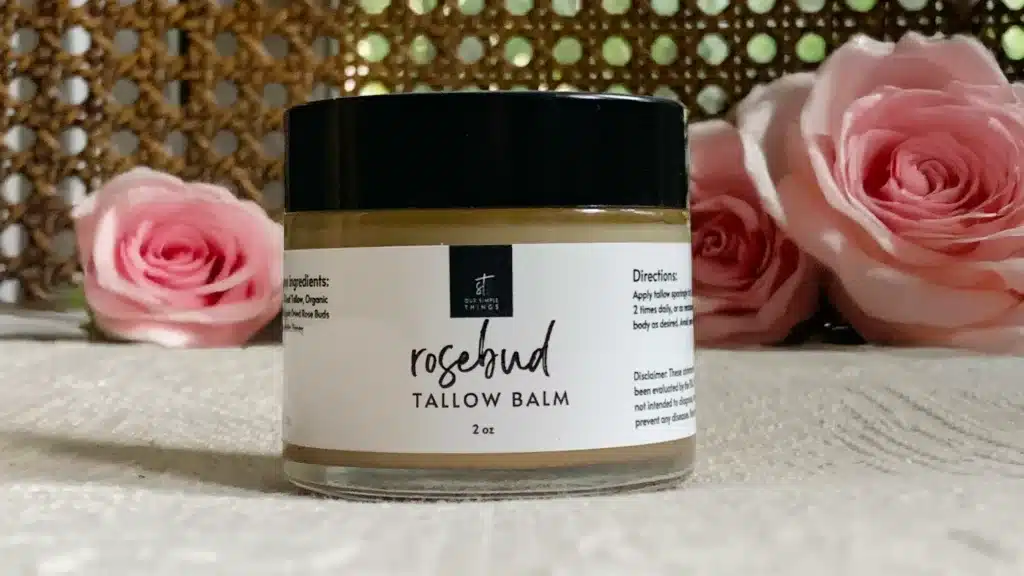
I gave her a sample of our Rosebud Tallow Balm and rubbed a little onto her arm. Rosebud is the one I personally use as a night cream, and it is usually the one I reach for when someone tells me their skin is very sensitive because it is soft, simple, and made without essential oils or added fragrance (like the rest of our line, but this one is made with extra gentle infusions of rose petals and rose hips).
She walked away to browse the market, and honestly, I did not expect her to come back. Usually when someone says they are going to walk around and “see how something feels”, that is their kind way of saying no thank you. I try not to take offense to that. People should have space to think about what they are putting on their skin.
But about 40 minutes later, she came back to the booth and asked, “What was that you put on my arm?” That one spot still felt soft and comfortable, even though it was hot out and the rest of her skin was already starting to feel (and look) dry again.
That interaction has stayed with me because she was not asking for a miracle. She was not asking me to fix a medical condition. She just wanted something that helped her skin feel cared for without feeling like she had to cover herself in something she did not want to use anymore.
That is really where this whole conversation should start. There’s a lot of bold claims online. Beef tallow balm itself does not treat or cure eczema, rashes, hormonal issues, or any skin condition. It is not a medication. But for dry, sensitive, moisture-starved skin, a simple balm can sometimes make a very real difference in how skin feels.
So what is beef tallow balm actually doing?
Beef tallow balms are not complicated. Beef tallow is rendered beef fat, often from suet (though some companies also use fat from around other organs), and in skincare it is used as a rich, oil-based moisturizer. Most tallow balms we have come across are blended with jojoba oil and essential oils, often to soften the texture and add scent. There is nothing unusual about that, but it is not how we make ours. We use grass-fed and finished beef tallow with organic emu oil, and our scents come from purposeful slow infusions of whole ingredients like rose petals, rose hips, pine needles, frankincense resin, myrrh gum, palo santo resin, herbs, and spices depending on the balm. We don’t use synthetic fragrance or essential oils in our tallow balms.
Unlike a typical lotion, which is often water-based and lighter in texture, tallow balm acts more like an ointment. It sits on the skin longer, softens dry areas, and helps create a protective layer that slows moisture loss. This is one reason people with very dry skin are often drawn to balms. They are not looking for something that disappears right away. They want something that stays, especially on hands, feet, elbows, cheeks, lips, and rough patches that seem to dry out again no matter what they use.
Of course, richer does not automatically mean better for everyone. Some people prefer lighter moisturizers, especially if they have oily or acne-prone skin. That is normal. Skin is personal. But for skin that feels dry, tight, rough, or easily irritated, a simple balm can be a good place to start.
Why dry skin needs more than a pretty lotion
Your skin barrier is the outermost layer of your skin. Its job is partly to keep moisture in and irritants out. When that barrier is dry or stressed, skin can feel rough, tight, flaky, itchy, or more reactive than usual.
That is why dermatology guidance puts so much emphasis on moisturizers, especially for people with eczema-prone or very dry skin. The American Academy of Dermatology recommends moisturizers for atopic dermatitis and says creams or ointments are usually preferred, along with products that are fragrance-free and dye-free. Source
This is also why some people end up relying on petroleum-based ointments. They work by sealing moisture in. I do not think it is helpful to shame people for that, because if your skin is miserable, you are going to use what helps you sleep. But I do understand why someone may eventually want a non-petroleum skincare option, especially if they are trying to simplify what they use every day.
Tallow balm gives people another option. Not a medical replacement. Not a cure. Just a rich, oil-based balm that can help skin feel softer and more protected.
What the research says about moisturizers and eczema-prone skin
There are not strong clinical studies showing that beef tallow balm itself treats eczema. That is important to say clearly.
But there is good research showing that moisturizers and emollients can support eczema-prone skin. A Cochrane review found that moisturizers may reduce eczema severity compared with no moisturizer, may reduce flares, and may reduce the need for topical corticosteroids in some cases. The same review also notes that the quality of the evidence was mostly low to moderate, so this is not a “moisturizers fix everything” situation. It is more like, “moisturizers are a basic, well-supported part of caring for dry, eczema-prone skin.” Source
The American Academy of Dermatology also includes moisturizers in its atopic dermatitis guidance. Their patient education materials say dermatologists recommend moisturizer for everyone with atopic dermatitis because keeping skin well moisturized helps prevent cracks and fissures that can make rash, itching, or infection worse. Source
So while I would never say, “Use tallow balm to treat eczema,” I do feel comfortable saying this: if your skin is dry, sensitive, or eczema-prone, a rich moisturizer can be part of a smart skin routine. For some people, tallow balm feels like the kind of moisturizer their skin has been asking for.
What about beef tallow specifically?
Beef tallow is made mostly of fats, and those fats are part of why it feels so rich on the skin. One study on beef tallow found that its major fatty acids include oleic acid, palmitic acid, and stearic acid. Source
That does not mean tallow is magic. It does not mean it is the same as your skin’s own oils. It also does not mean it will work for every skin type. But it does help explain why it has that soft, cushiony, protective feel that people notice right away.
And this is where I think the conversation around tallow can get a little silly online. Some people talk about it like it can fix everything. Other people dismiss it completely because it sounds too old-fashioned. I think the truth is quieter than that. Tallow is a simple, rich, animal-based fat that can make a beautiful balm for dry skin when it is sourced well, rendered well, and blended thoughtfully.
That is enough. It does not need to be overpromised.
Can beef tallow balm help eczema?
This is probably the question that brings a lot of people here, so let’s answer it plainly.
Beef tallow balm does not treat, cure, or prevent eczema. Eczema is a medical condition, and if you have severe itching, open skin, weeping, infection, pain, spreading patches, or symptoms that are not improving, it is time to talk with a dermatologist or qualified healthcare provider. From our own personal experience, our son’s eczema was his skin telling us there was a deeper issue within – namely his gut health and inflammation. We soothed his skin with our balms and salves while working on improving his gut health.
That said, many people with eczema-prone skin are simply trying to keep their skin moisturized between flares, or they are looking for something gentle to use on dry, rough, uncomfortable areas. Some people have told us that our balms have helped their skin feel softer, calmer, and less dry. Those stories matter to me, but they are personal experiences, not medical studies.
There is a difference between saying, “This cured my eczema,” and saying, “This helped my skin feel more comfortable.” We stay in the second lane because it is honest.
The FDA explains that products claiming to diagnose, cure, mitigate, treat, or prevent disease can be considered drugs, not cosmetics. Source Our balms are skincare. They are made to moisturize, soften, protect, and care for dry skin. They are not drugs, and they are not meant to replace medical care.
Why ingredient simplicity matters
Sensitive skin does not always need more. A lot of the time, it needs less.
That is one of the reasons I formulate our skincare the way I do. I look to tallow, emu oil (deeply penetrative), and plants that have science and history behind them.
The American Academy of Dermatology recommends fragrance-free products for eczema-prone skin, and they specifically point people toward moisturizers that do not contain fragrance, perfume, or dyes. Source That lines up with what we hear from customers all the time. People with sensitive skin are tired of mystery scents, burning lotions, and products that look gentle but are still full of things their skin does not like. We have also had many come to us who had been given other balms with essential oils, only to have their skin feel worse. For some, essential oils are just too strong and disrupt the skin barrier even more.
Now, I also want to say this because it matters: natural ingredients can bother some people too. Just because something comes from a plant, resin, flower, or animal fat does not mean every person’s skin will love it. That is why patch testing matters. Especially if your skin is reactive, if you have allergies, or if you are trying a balm with herbs or resins in it.
Rosebud, Wildwood, Grounded, and choosing the right balm
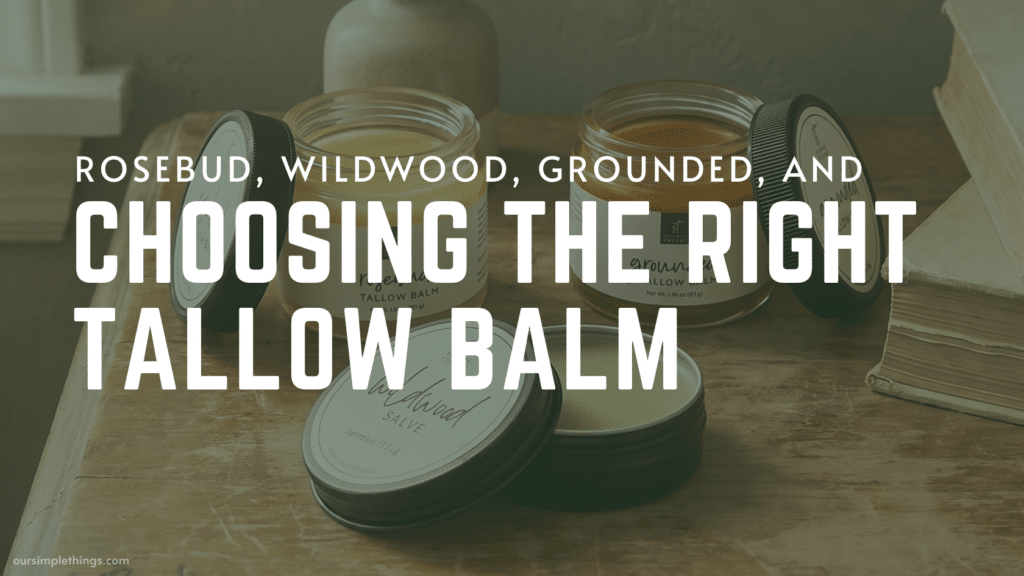
If someone is brand new to tallow, I usually point them toward Rosebud Tallow Balm or Wildwood Salve first, especially if they are shopping for babies, children, postpartum skin, or very sensitive skin. Rosebud is the one I personally use as a night cream, and I love how simple it is. It feels soft and buttery without feeling overly heavy. It is made with grass-fed and finished beef tallow, organic emu oil, organic dried rose buds and petals, and organic dried rose hips, so it is a gentle place to start for people who want a simple, essential-oil-free balm.
Wildwood Salve is another one I recommend often for babies and sensitive skin. It is still simple and tallow-based, but it has a slightly different feel because it is made with grass-fed and finished beef tallow, organic emu oil, beeswax, organic eucalyptus leaves, organic balsam fir needles, and pine gum rosin. I think of Wildwood as a good choice for families who want something more salve-like, with a little more protective staying power from the beeswax, while still avoiding essential oils and synthetic fragrance.
Grounded Tallow Balm is a different kind of balm. It is made with grass-fed and finished beef tallow, organic emu oil, magnesium chloride, pine gum rosin, organic pine needles, organic frankincense resin, red sandalwood powder, palo santo powder, and organic rosemary leaves. It is a more potent blend, and while many people love it, I do not usually recommend Grounded as the first choice for babies or very reactive skin. I also would not use it on open sores, cracked-open skin, or raw areas because the magnesium may sting (and no one needs that when their skin is already upset). Patch test first, especially if your skin is irritated, sensitive to magnesium, or reactive to plant materials.
I think of Rosebud as the soft, gentle, everyday balm. Wildwood is the more protective, woodsy salve I feel good about recommending for babies and families who want something simple but a little sturdier on the skin. Grounded is the earthy, stronger-feeling balm for people who already know their skin likes those ingredients and want a more intensive option. None of them are medical treatments. They are just different tools for different skin needs.
If you are looking specifically for gentle support or want to learn more about eczema-prone or rash-prone skin, we also have a full page on that here: Eczema & Rashes. Skincare cannot treat or cure eczema, rashes, or any medical condition, but low-irritation, barrier-supportive formulas can help dry skin feel more comfortable while you work through the bigger picture.
Tallow balm vs. Vaseline
Vaseline is petroleum jelly, and it is often recommended because it is a strong occlusive. That means it helps seal moisture in. There is a reason people with very dry skin reach for it, and I do not want to pretend it has not helped a lot of people.
But some people do not want to use petroleum-based products every night, and I understand that too. Sometimes the issue is not, “Does this work?” Sometimes the issue is, “Do I feel good using this over and over again?”
Tallow balm is also rich and protective, but it is a very different kind of product. Instead of petroleum jelly, it is made with rendered animal fat and other whole ingredients. It has a different texture, a different feel, and a different ingredient story. For someone who wants a non-petroleum balm for dry skin, tallow can be a beautiful option.
This does not mean everyone needs to throw away what they already use. It just means there are other choices.
Who should be cautious with beef tallow balm?
I wish every product worked for every person, but that is not real life. Some people love tallow on their face. Some people only like it on their hands, feet, elbows, or lips. Some people with oily or acne-prone skin may find it too heavy.
Dermatologists have also pointed out that beef tallow may not be ideal for oily or acne-prone skin, and that there is still limited research on tallow as a skincare ingredient. Source That does not scare me away from tallow, but it does keep me honest about it. I personally can be prone to acne and excess oil, however, I react well to our tallow balms if I use them right after cleansing my face. However, I do prefer to use it at night on my face, and our more lightweight face oils during the day. I switch off between Radiance Oil and Awaken Oil.
Patch test first if you have very reactive skin, acne-prone skin, known allergies, broken skin, or a history of reacting to herbs, resins, waxes, or animal-based ingredients. Use a tiny amount. Give your skin time. More balm is not always better.
And if you are dealing with a rash that is spreading, painful, weeping, bleeding, infected, or not improving, please do not try to guess your way through it with skincare. Get medical help. Skin issues can have many causes, and sometimes you need someone trained to look at it.
How to use beef tallow balm for dry skin
Start with less than you think. Truly. A little balm can cover a lot of skin, especially if your skin is slightly damp.
I like applying balm after washing or bathing, once the skin is clean and still has a little moisture on it. Warm a small amount between your fingers, then press or smooth it into the dry areas. For the face, start with a tiny amount. For hands, feet, elbows, and knees, you can usually use a bit more.
For nighttime, I love Rosebud as the last step on my face. I do not use a lot. Just enough to leave my skin feeling soft and cared for before bed. It is one of those small routines that feels simple in the best way (and I am all for a routine that does not require twelve products and a spreadsheet).
For babies or children, keep it simple and patch test first. Avoid using any balm on open, weeping, infected, or unexplained rashes unless a healthcare provider has told you it is okay.
What beef tallow balm can and cannot do
A good tallow balm can help dry skin feel softer, more moisturized, and more protected. It can help rough areas feel smoother. It can create a rich barrier that helps slow moisture loss. It can be part of a simple skincare routine for people who want fewer ingredients and no synthetic fragrance.
A tallow balm cannot treat eczema, cure rashes, prevent disease, balance hormones, heal infections, replace medication, or diagnose what is happening with your skin.
I know that may sound repetitive, but I think it is worth saying more than once because people are being sold a lot of big promises online. I do not want to build trust with a dramatic claim. I would rather tell the truth and let the product be what it is: simple, rich, nourishing skincare.
Final thoughts
The woman at the market did not come back because I gave her a perfect speech about tallow. She came back because her skin felt different in a way she could notice. That is the kind of thing that stays with me.
Not because it proves anything in a clinical sense. It does not. One woman’s arm at one market is not a study. But it is a reminder that real people are out there trying to feel better in their own skin, and a lot of them are tired of products that feel disconnected from the kind of life they are trying to live.
Beef tallow balm is not a cure. It is not medicine. It is not for everyone. But for dry, sensitive skin that needs something rich, simple, and protective, it can be a really lovely place to start.
Patch test. Use a small amount. Pay attention to your skin. And if something feels beyond normal dryness, get help from someone qualified.
Simple care still deserves wisdom.
FAQ
Is beef tallow balm good for dry skin?
Beef tallow balm can be a good option for dry skin because it is rich, oil-based, and helps create a protective layer on the skin. It works more like an ointment than a lotion, so many people like it for rough patches, hands, feet, elbows, cheeks, and lips.
Can beef tallow balm help eczema?
Beef tallow balm does not treat or cure eczema. Some people with eczema-prone skin find rich balms helpful for dryness and comfort, but eczema is a medical condition. Research does support moisturizers and emollients as part of eczema care, but there are not strong clinical studies proving that beef tallow itself treats eczema. Source
Is beef tallow balm safe for sensitive skin?
It depends on the person and the formula. Many people with sensitive skin prefer simple, fragrance-free balms, but any ingredient can bother someone. Patch test first, especially if you are sensitive to animal fats, herbs, resins, waxes, or botanicals.
Can I use beef tallow balm on my face?
Yes, many people use tallow balm on the face, especially if their skin is dry. Start with a tiny amount. If your skin is oily or acne-prone, test carefully because rich balms can feel too heavy for some people.
Does beef tallow clog pores?
It can for some people. The biggest thing is that it always needs to be applied to a clean face. Skin response varies. If you are acne-prone, oily, or prone to clogged pores, use a very small amount and patch test before applying it widely on your face.
Is tallow balm better than lotion?
Not always. Lotion is usually lighter and often water-based. Tallow balm is richer and more protective, which can be helpful for very dry skin. Some people like both: lotion for lighter moisture and balm on top when they need something that lasts longer.
Is Rosebud Tallow Balm the best place to start?
For many people, yes. Rosebud is a gentle option because it is made without essential oils or added fragrance, and it uses simple rose and rose hip infusions. It is the one I personally reach for as a night cream and often suggest first for sensitive skin.
Sources
- American Academy of Dermatology: Atopic Dermatitis Treatment
- American Academy of Dermatology: Eczema Friendly Products
- Cochrane: Emollients and Moisturizers for Eczema
- Journal of Applied Pharmaceutical Science: Beef Tallow Fatty Acid Composition
- FDA: Is It a Cosmetic, a Drug, or Both?
- Verywell Health: Beef Tallow Moisturizer