Quick answer: Lip balm is not food and shouldn’t be intentionally eaten. But accidentally swallowing the tiny amount that wears off during ordinary use is unlikely to cause symptoms with most common lip balms.
Let’s Talk About the Thing No One Wants to Think About
You know that balm you swipe on five times a day without even thinking? You’re probably eating it. Not intentionally, obviously, but between lip licking, sipping coffee, and just being a human with a mouth, a good chunk of that balm isn’t staying put. So, is lip balm edible?
While there’s no single definitive study quantifying daily lip balm ingestion, it’s well accepted in dermatology and toxicology circles that lip products are partially ingested through normal use, especially with frequent reapplication. That makes ingredient quality a bigger deal than most people realize.
Lip Products and Long-Term Exposure Risks
Lip products can contain trace metals, fragrance and flavor mixtures, sunscreen ingredients, and other potential irritants. That matters a little more when we’re talking about something applied directly to the mouth, several times a day, for years.
The FDA tested hundreds of cosmetic products and found that more than 99% contained less than 10 parts per million of lead. The agency concluded that exposure from incidentally swallowing a lip product containing lead at that level would be very small and would not pose a health risk.
That’s reassuring, and it deserves to be said.
But it also confirms something we tend to ignore: exposure from lip products happens mainly because we swallow some of what we apply. It doesn’t all stay politely on our lips.
A 2013 study published in Environmental Health Perspectives tested 32 lipsticks and lip glosses for nine metals. The researchers detected lead in 24 of the 32 products, along with varying amounts of aluminum, cadmium, chromium, manganese, and other metals.
To estimate exposure, they used an average-use amount of 24 mg of lip product per day and a high-use amount of 87 mg per day. Those figures came from previous usage research, and the researchers assumed that all applied product was eventually ingested.
That doesn’t prove everyone swallows 87 mg of lip balm every day, and it doesn’t prove that the products caused anyone harm. It was a small, preliminary study.
It did, however, find that estimated exposure to certain metals, particularly chromium, and under high-use assumptions, aluminum and manganese, deserved more investigation. That’s enough for me to care about sourcing, manufacturing, pigments, and the quality of ingredients used in something that lives on the mouth.
You can read the 2013 metal exposure study here and the FDA’s lead assessment here.
Metals aren’t the only consideration.
Flavorings, fragrances, lanolin, sunscreen ingredients, waxes, and botanicals can all trigger irritation or allergic contact cheilitis in certain people. A published case report identified an allergic reaction to benzophenone-3, a UV filter used in some SPF lip products, along with fragrance and flavor ingredients.
The American Academy of Dermatology also advises people with already-chapped lips to avoid ingredients such as camphor, fragrance, menthol, certain flavors, phenol, lanolin, octinoxate, and oxybenzone while their lips heal.
That doesn’t mean every person will react to those ingredients. It means burning, stinging, and tingling aren’t necessarily signs that a product is “working.” Sometimes your lips are simply telling you they don’t like it.
What About Petroleum-Based Lip Balm?
Petrolatum, mineral oil, and paraffin are widely used in lip care because they form an occlusive layer that slows moisture loss.
They are not automatically toxic.
European rules allow mineral oils in cosmetics when the refining history is known and the starting material is free of carcinogenic substances or properly tested. Germany’s Federal Institute for Risk Assessment has said that health risks from highly refined mineral oils in cosmetics are not expected based on current knowledge.
It has also acknowledged gaps in the data around oral exposure from lip products and recommended minimizing mineral oil aromatic hydrocarbons, or MOAH, where technologically possible. German Federal Institute for Risk Assessment
So no, I’m not going to tell you that every petroleum-based lip balm is poison.
I’m also not going to pretend it’s the only way to make a good balm.
I would rather build mine around tallow, Nilotica shea butter, and beeswax. I like what those ingredients bring to the formula, and I don’t need petroleum to make a balm that feels good and stays put.
Petroleum may be common. It still doesn’t have to be my choice for something I put on my mouth all day.
But It’s Just a Little, Right?
That’s what we tell ourselves: “It’s only a little bit.”
And yes, dose matters. A tiny amount of an ingredient isn’t automatically dangerous simply because we can detect it. Finding something and proving that it causes harm are two very different things.
But repeated use is still repeated use.
If I apply something several times a day, every day, I want to understand what’s in it. I want to know why each ingredient is there, and I want to decide for myself whether it belongs in something I use that often.
A 2004 study detected parabens in 20 breast-tumor samples, but it did not establish that parabens caused the tumors or show what cosmetic use means for human health. The FDA currently says it does not have information showing that parabens, as used in cosmetics, affect human health.
I still choose not to use them in our lip balms because our formulas don’t need them.
Phthalates are a family of different chemicals with different uses and risk profiles. Some have been studied for possible reproductive and endocrine effects, but the FDA says it does not currently have evidence that phthalates, as used in cosmetics, pose a safety risk.
Again, I don’t have to call an ingredient poison to decide I don’t want it in my formula.
Menthol, camphor, phenol, and certain flavors can irritate lips that are already dry or chapped. The American Academy of Dermatology recommends avoiding those ingredients while chapped lips heal. Irritation may make someone reach for more balm, but “lip balm dependency” isn’t a medical diagnosis.
You don’t have to be scared, just awake.
Personally, if a label only says “flavor” or “fragrance,” I don’t love not knowing what else is coming along for the ride with my morning coffee.
Relevant sources: FDA on parabens, FDA on phthalates, and American Academy of Dermatology.
The Label Trick: Why You’re Not Always Told
Let’s talk about “flavor” and “fragrance.”
Under U.S. cosmetic-labeling rules, the individual ingredients inside a fragrance or flavor mixture do not always have to be listed separately. The mixture may simply appear on the label as “fragrance” or “flavor.”
That is legal. It also means the label may not tell you every component inside that mixture.
Those ingredients aren’t automatically dangerous. But if you’re sensitive to a particular fragrance or flavor component, “fragrance” doesn’t give you much help.
That isn’t enough transparency for me.
The whole reason lip products include flavors and scents is that we taste and smell what we put there. When you rub vanilla lotion on your leg, you don’t taste it. Put birthday-cake flavor on your lips, and suddenly it’s part skincare and part snack experience.
If that’s what you enjoy, that’s your choice.
It isn’t what I want to formulate or use personally.
I want lip balm to do its job without relying on candy-sweet flavor oils, a manufactured tingle, or hiding half the story behind one word on the label.
Our Approach: Keep It Simple
Here’s what we do put in our lip balms:
- Grass-fed tallow – gives the balm a rich, emollient base and staying power, nutrient-rich, and skin-compatible
- Nilotica shea butter – adds a softer, creamier glide, loaded with fatty acids
- Beeswax – gives the balm structure and helps it stay put
- Purposeful infused botanicals – used when they add something specific, such as botanical tint or character
What we don’t use? Parabens. Phthalates. Petroleum. Flavor oils. Essential oils (read why here). Menthol. Salicylic acid. Fake colors. “Clean” buzzwords or greenwashed labels. If it doesn’t serve your skin, it doesn’t make the cut.
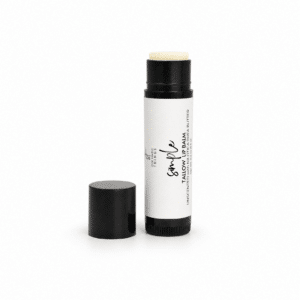
Our Simple Tallow Lip Balm is plain, unscented, and made with those three ingredients. It’s the one for people who want their lip balm to quietly do its job without tasting like dessert.
If you want more than just a plain lip balm, we are always expanding our offerings following the same criteria, including tallow lip tints and botanical infused tallow lip balms.
Showing all 4 resultsSorted by popularity
-
Natural Lip Care
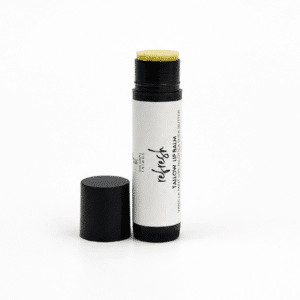
Refresh Vanilla Mint Tallow Lip Balm
$6.00 — or Original price was: $6.00.$5.70Current price is: $5.70. / month Add to cart -
Aging & Texture Support
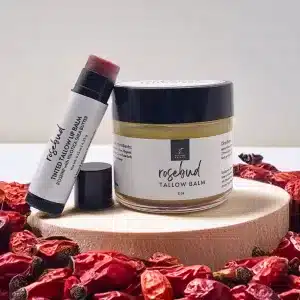
Rosebud Bundle
Original price was: $28.00.$25.00Current price is: $25.00. — or Original price was: $28.00.$25.00Current price is: $25.00. / month Add to cart -
Aging & Texture Support
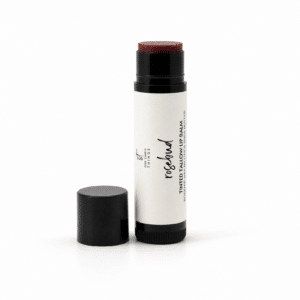
Rosebud Tinted Tallow Lip Balm
$6.00 — or Original price was: $6.00.$5.70Current price is: $5.70. / month Add to cart -
Babies & Gentle Skincare
Simple Tallow Lip Balm
$5.00 — or Original price was: $5.00.$4.75Current price is: $4.75. / month Add to cart
Frequently Asked Questions
Can You Eat Lip Balm?
Lip balm is a cosmetic, not food, so it shouldn’t be intentionally eaten. Accidentally swallowing the tiny amount that comes off during normal use is unlikely to cause symptoms with most common lip balms.
Can You Eat ChapStick?
ChapStick and similar lip products are intended for external use. Poison Control says a small accidental amount is unlikely to cause symptoms, although formulas containing camphor or menthol may carry a greater risk of side effects.
What Should I Do If My Child Eats Lip Balm?
Don’t induce vomiting. Contact Poison Control online or call 1-800-222-1222 in the United States. They can give advice based on the specific product, amount swallowed, age, and symptoms.
Is Tallow Lip Balm Edible?
No. A tallow lip balm is still a cosmetic even when some of its ingredients also have food-related uses. Use it on the lips as directed; don’t intentionally eat it.
Can Natural Lip Balm Irritate Your Lips?
Yes. People can react to naturally derived ingredients, including botanicals, essential oils, honey, and waxes. Review the full ingredient list and stop using anything that causes burning, swelling, or worsening irritation.
Why Do I Have to Keep Reapplying Lip Balm?
Lip balm naturally wears off when you eat, drink, talk, lick your lips, or wipe your mouth. Weather and the condition of your lips also affect how often you want to reapply. Reapplication by itself doesn’t mean you’re “addicted” to lip balm.
Final Thoughts
I’m not trying to scare anyone out of using lip balm. Quite the opposite.
The tiny amount swallowed during normal use is unlikely to be a problem with most formulas. But because lip balm is something many of us use repeatedly, I still think the ingredient list deserves a look.
If I’m using something that ends up in my body, even in trace amounts, I want it to be simple, effective, and built on purpose. I don’t want a petroleum-based formula or an undisclosed fragrance blend.
For me, simple wins. That’s why I make mine the way I do.
References
- Darbre, Philippa D., et al. “Concentrations of parabens in human breast tumours”. Journal of Applied Toxicology, vol. 24, no. 1, 2004, p. 5-13. https://doi.org/10.1002/jat.958
- U.S. FDA. Limiting Lead in Lipstick and Other Cosmetics.
- Liu, S., Hammond, S. K., & Rojas-Cheatham, A. (2013). “Concentrations and Potential Health Risks of Metals in Lip Products.” Environmental Health Perspectives, 121(6), 705–710. https://doi.org/10.1289/ehp.1205518
- DermNet NZ. Allergic Contact Cheilitis.
- Schram, Sarah E et al. “Allergic contact cheilitis from benzophenone-3 in lip balm and fragrance/flavorings.” Dermatitis : contact, atopic, occupational, drug vol. 18,4 (2007): 221-4. doi:10.2310/6620.2007.06071
- Poison Control: What You Need to Know About Lip Products
- FDA: Limiting Lead in Lipstick and Other Cosmetics