Quick answer: Some lip balms can leave your lips feeling drier when they contain ingredients that irritate already-chapped skin, encourage lip licking, or wear off without giving the lip barrier enough lasting protection. Lip balm is not chemically addictive, but the wrong formula can keep you stuck in a very real irritation and reapplication cycle.
If you have lip balm in your purse, your car, your nightstand, and possibly the pocket of every coat you own, yet your lips are still dry, we need to talk.
If you have ever searched, “why does lip balm make my lips dry?” after applying it for the fifteenth time that day, you are not imagining the pattern. The balm may feel good for ten minutes, then your lips feel tight again, so you swipe on more. Repeat until you start wondering whether your lips have developed a tiny and expensive dependency.
They have not. But something is keeping the cycle going.
The usual problem is not lip balm as an entire category. It is a combination of a delicate lip barrier, irritating ingredients, licking, weather, and formulas that provide a quick sensation without enough staying power.
Come nerd out with me for a minute, because lips are strange little pieces of skin.
Why Lips Dry Out So Easily
The visible pink or red part of the lips is called the vermilion. It does not have the same oil-gland support as the regular skin on your face, and its barrier is unusually vulnerable to water loss. Your lips are also constantly dealing with wind, sun, saliva, food, drinks, toothpaste, and whatever skincare accidentally travels too close to your mouth.
In a study of people with chronic cheilitis, researchers measured significantly greater transepidermal water loss and lower hydration in the lips compared with healthy controls. In normal language, irritated lips were losing more water and holding less of it. That does not mean every case of dry lips is cheilitis, but it helps explain why lips can become dry and uncomfortable so quickly.
Once that barrier is struggling, an ingredient that never bothered you before may suddenly feel like a personal attack.
The Lip Balm Irritation Cycle
The cycle usually looks something like this:
- Your lips feel dry, so you apply balm.
- The balm gives you slip, shine, flavor, or a cooling tingle.
- An irritating ingredient, lip licking, or simple wear removes that temporary relief.
- Your lips feel tight again, so you apply more.
- Nothing gets a long enough break to settle down.
Reapplying lip balm is not automatically a problem. Lip products wear off when we eat, drink, talk, wipe our mouths, and exist as people with faces. The red flag is needing more every few minutes while your lips become increasingly dry, sore, scaly, or irritated.
The Tingle May Be Irritation, Not Evidence That It Is Working
Menthol, camphor, phenol, eucalyptus, and strong mint or cinnamon flavorings can make a lip product feel cooling, plumping, or medicated. That sensation is easy to interpret as action.
Sometimes the action is simply irritation.
The American Academy of Dermatology advises people with chapped lips to stop using products that burn, sting, or tingle. Its list of ingredients that may irritate already-chapped lips includes camphor, fragrance, menthol, phenol, lanolin, salicylic acid, eucalyptus, and certain flavors, including cinnamon, citrus, mint, and peppermint.
That does not mean every person will react to every ingredient on that list. It also does not mean a gentle whole-plant infusion is identical to concentrated essential oil or menthol crystals. It means your own lips get the final vote. If a product burns or makes the problem worse, stop using it.
Flavor Can Keep Your Tongue Involved
Birthday cake, cola, cotton candy, tropical punch. At some point, lip care became a snack aisle.
A sweet or strongly flavored balm can make you lick your lips more often without realizing it. Saliva briefly wets the surface, but as it evaporates, the lips can feel even drier. The American Academy of Dermatology specifically warns that frequent licking can worsen chapping.
Flavor and fragrance ingredients can also trigger irritant or allergic contact cheilitis in some people. According to the FDA’s information on cosmetic allergens, fragrances are one of the common classes of cosmetic allergens, and the individual components of a fragrance mixture may not always appear separately on the label.
Natural does not guarantee non-irritating, either. Botanicals, beeswax, honey, lanolin, and essential oils can all be a problem for the person who happens to be sensitive to them. A short ingredient list makes troubleshooting easier, but no ingredient is universally perfect for every human.
Some Formulas Give Slip Without Much Staying Power
There is a difference between making lips feel slippery and helping them hold on to water.
Oils and butters act as emollients. They soften the surface and fill some of the spaces between dry skin cells. Waxes and other occlusives help form a film that slows water loss. A useful lip balm often combines those jobs so it feels comfortable and stays put.
If a formula disappears quickly, your lips are exposed again quickly. That does not mean the product secretly stole moisture from your lips. It may simply mean the relief was too temporary for lips that were already in rough shape.
And for the sake of scientific honesty, plain petrolatum does not cause a true dependency or automatically dry the lips. It is a very effective occlusive, and dermatologists often recommend white petroleum jelly for severely chapped lips.
I still prefer to formulate with traditional fats, shea butter, and beeswax, especially for something used on the mouth. That is my formulation choice. I personally dont like the thought of ingesting petroleum jelly.
Are You Addicted to Lip Balm?
“Lip balm addiction” is not a recognized chemical addiction. Your lips do not forget how to moisturize themselves because you used balm.
What can happen is a habit loop. Your lips feel tight, you apply something, you get a brief sensory reward, it wears off, and you reach for it again. If the product also contains an irritant, or the flavor has you licking your lips, the loop becomes even stronger.
There is also a much simpler possibility: your lips are genuinely dry and the balm is helping, so you notice when it wears off. Reapplication alone does not prove anything is wrong.
The better question is not, “How often do I use lip balm?” It is, “Are my lips becoming calmer and more comfortable over time?”
Why Can a Layer of Dead Skin Come Off After Switching Balms?
This is where it gets interesting.
I have heard a very specific observation from people who came to my tallow lip balms with chronically dry-feeling lips. Their lips felt more comfortable, then over the next day or two, a layer of dry skin loosened and came off. The surface underneath felt noticeably softer and more supple.
Those are customer observations, not the results of a clinical trial on my lip balm. Still, there is a biologically plausible explanation for what they noticed.
The outermost layer of skin is made of flattened cells called corneocytes. Those cells are supposed to loosen and shed in an orderly process called desquamation. Tiny protein structures help hold the cells together, and enzymes help break those connections when it is time for the surface cells to release.
Dry skin does not always shed neatly. It can accumulate retained, uneven corneocytes, which we see as roughness, flakes, or a compacted layer of scale.
A 2021 study of 40 women found that lower lip hydration was associated with more severe, uneven lip scaling. The researchers also found differences in enzymes involved in the shedding process.
An earlier lip study found lower hydration and reduced cathepsin D activity in severely chapped areas. Cathepsin D is one of the enzymes involved in breaking down the structures that hold surface cells together.
This lines up with the larger body of skin-barrier research. Delayed desquamation can cause corneocytes to accumulate at the surface, while hydration and enzyme activity help regulate how those cells release.
So, could a richer, longer-lasting balm reduce water loss, soften that retained layer, and allow it to loosen over the next day or two? Yes, that is plausible.
Chronic dryness may have disrupted normal shedding. Once the surface stays softer and better protected, some of that retained scale may finally release more evenly.
That also explains why the skin underneath may feel so much smoother. The balm did not chemically peel the lips. The rough layer simply may not be clinging as tightly anymore.
Let it come off on its own. Pulling, biting, or scrubbing at loose skin can create tiny injuries and restart the irritation cycle.
If peeling comes with burning, swelling, worsening redness, blisters, or raw skin, that is a different situation. Stop using the product and consider an allergy or another cause.
Why I Make Tallow Lip Balm for Dry Lips
My goal with lip balm is not to create the strongest flavor, the iciest tingle, or something you feel compelled to reapply every four minutes. I want it to quietly do its job.
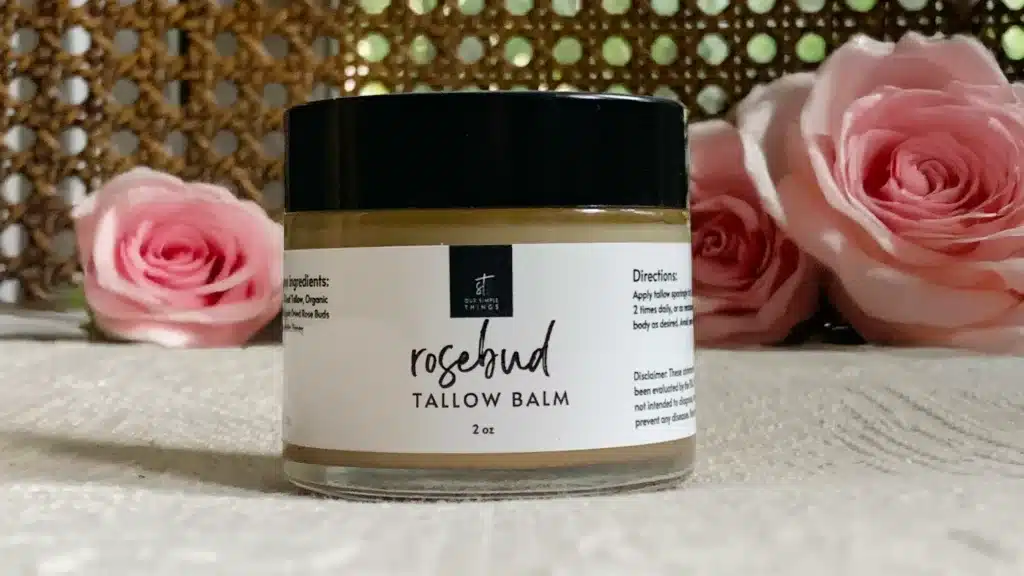
Our tallow lip balm formula combines grass-fed and finished beef tallow, organic Nilotica shea butter, and beeswax. Tallow and Nilotica shea butter provide the emollient base, helping soften rough surface cells and improve glide. Beeswax gives the formula structure, staying power, and a protective film that helps slow moisture loss.
That combination matters. A balm cannot pour water into your lips, but it can help reduce how quickly the water already there escapes. Hydration come from within, we are just trying to keep it within.
It can also make a dry, uneven surface feel softer while the lip barrier gets a break from wind, licking, and repeated irritation.
For lips that are already reactive, I would start with Simple Tallow Lip Balm. It has only three ingredients and contains no essential oils, flavor oils, synthetic fragrance, sweeteners, dyes, menthol, or peppermint oil.
If you want to see the full collection, you can browse our tallow lip care here.
Tallow is not a magic spell, and I am not going to claim that one balm can fix every cause of chapped lips. I make it because the formula gives me the softness, protection, and staying power I want without relying on petroleum, synthetic fragrance, concentrated essential oils, or a manufactured tingle.
Simple wins again.
How to Break the Dry-Lip Cycle
If your current balm seems to be making things worse, give your lips a boring little reset. Boring is underrated.
1. Stop Anything That Burns, Stings, or Tingles
Do not power through irritation because the label says “medicated,” “plumping,” or “cooling.” Your lips are not a gym. They do not need to feel the burn.
2. Use One Simple, Non-Irritating Balm
Choose a formula with a full ingredient list and enough staying power to protect the surface. If your lips are very reactive, start with an unscented, flavor-free option like our Simple Tallow Lip Balm.
Using one product at a time also makes it much easier to identify a problem ingredient.
3. Apply It When It Can Actually Stay Put
Use balm after eating or drinking, before going outside, and before bed. Reapply when it has worn off or your lips feel unprotected.
There is no prize for using the least lip balm, and there is no need to swipe it on every time you look at the tube.
4. Leave the Flakes Alone
No biting. No pulling. No toothbrush exfoliation on cracked lips.
If retained dry skin starts to soften and release, let it do that without turning it into something worse. I know it’s hard. Even I struggle with wanting to compulsively pick at my skin sometimes.
5. Look Beyond the Balm
Lip licking, cold or windy weather, sun exposure, mouth breathing, toothpaste, dental products, certain foods and facial skincare can all contribute.
Retinoids, exfoliating acids, and benzoyl peroxide are particularly good at wandering onto places where they were never invited.
6. Protect Your Lips From the Sun
The American Academy of Dermatology recommends SPF 30 or higher on the lips when outdoors, particularly with zinc oxide or titanium dioxide.
If a sunscreen lip product irritates you, ask a dermatologist for help finding one you tolerate rather than skipping protection entirely.
7. Know When It Is Not a Normal Case of Chapped Lips
If your lips are not noticeably improving after two to three weeks of gentle care, see a dermatologist.
Persistent scaling can come from allergic contact cheilitis, infection, eczema, medication effects, nutritional issues, or sun damage. A persistently dry, rough patch on one lip deserves professional attention because actinic cheilitis can be precancerous.
What Should You Look for in a Lip Balm?
You do not need a chemistry degree. Start here:
- A complete ingredient list
- No burning, stinging, or swelling when you apply it
- Minimal fragrance and flavor, especially while your lips are chapped
- Enough emollience to soften rough skin
- Enough staying power to slow water loss
- A formula you can use consistently without licking or picking at your lips
If you use a balm several times a day, ingredient transparency matters. Lip products do not stay politely on the surface forever.
If you want to nerd out about that part too, read How Much Lip Balm Are We Actually Eating?.
Final Thoughts
Lip balm should make your lips more comfortable, not keep you trapped in a minty little emergency.
If your lips feel worse every time a product wears off, pay attention to the formula, the sensations it creates, and what your tongue is doing all day. Remove the likely irritants. Give the barrier enough protection to settle down. Then give it a little time.
And if a dry layer softens and sheds after your lips finally stay comfortable for a day or two, don’t panic. It may simply be normal shedding getting back on track.
Ready for simpler lip care? Shop our tallow lip balms.
References
- Kim J, et al. “Relationship between lip skin biophysical and biochemical characteristics with corneocyte unevenness ratio as a new parameter to assess the severity of lip scaling.” International Journal of Cosmetic Science. 2021. https://doi.org/10.1111/ics.12692
- Hikima R, et al. “Development of lip treatment on the basis of desquamation mechanism.” International Journal of Cosmetic Science. 2004. https://doi.org/10.1111/j.1467-2494.2004.00217_01.x
- Rawlings AV, Voegeli R. “Stratum corneum proteases and dry skin conditions.” Cell and Tissue Research. 2013. https://doi.org/10.1007/s00441-012-1501-x
- Wang Y, et al. “Analysis of clinical presentations, lip transepidermal water loss and associated dermatological conditions in patients with chronic cheilitis.” Journal of Cosmetic Dermatology. 2022. https://pmc.ncbi.nlm.nih.gov/articles/PMC9797544/
- American Academy of Dermatology. “7 dermatologists’ tips for healing dry, chapped lips.” Read the guidance
- U.S. Food and Drug Administration. “Allergens in Cosmetics.” Read the FDA guidance